How quotas affect delivery of services to women
 On the Washington Post’s Monkey Cage blog, Lindsay Benstead discusses her new article in Governance on the relationship between gender-based quotas and the provision of government services to women. Read the article.
Perverse incentives discourage attention to big questions
 Robert F. Durant responds to Don Kettl’s commentary on the neglect of big questions in public administration: As usual, Don Kettl makes several excellent points in his commentary about the so-called “big questions” in public administration and public management. As one of those who has written about and lectured on the negative impacts of general trends in the field on junior (and senior) scholars (1), I would add a friendly amendment to his point regarding the rewards to be gained by addressing big questions.
To address the problem requires more than accurately pointing out that Simon or others of his era focused on big questions and garnered big professional rewards from doing so. Scholars—new and seasoned—face a very different set of incentive structures as professionals today than did those in Simon’s day, or even two decades ago. Read the rest of this entry »
The world is doing better than you think
 It’s easy to be pessimistic about the state of the world, Steven Radelet writes in a new commentary for Governance. But developing countries are doing much better in many ways: They are healthier, wealthier, more peaceful, and more democratic. Will this “great development transformation” continue? It can, says Radelet, if we take three critical steps. “Continued progress for the world’s poor will require persistent commitments to improved governance.” Free access to the commentary.
Book reviews: Curbing corruption, managing public investment
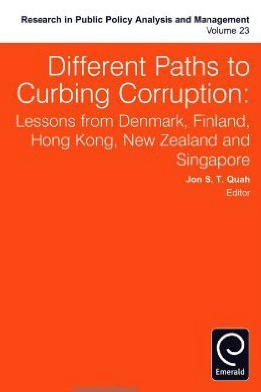 In the current issue of Governance, Kilkon Ko reviews Different Paths to Curbing Corruption, edited by Jon S.T. Quah. The book examines anti-corruption policies in six countries and provides “much insight” on the keys to success in fighting corruption. Read the review.
Comment: In defense of big questions
This draft comment has been prepared for a panel on public management research and the state to be held at the research conference of the Public Management Research Association at the University of Aarhus in June 2016. Comments and responses are welcome. See other posts relating to this discussion.
By Donald F. Kettl. Bubbling in the background of public management research is a huge puzzle: are researchers spending far too little time on the really big questions in the field, because of a growing instinct to drill ever-deeper into ever-smaller questions?
In a 2015 Public Administration Review article, Bradley E. Wright applauds the progress that the field has made in resolving some of its fundamental questions. The reason, he argues, is that the field “has become much more scientific” in the last two generations, because of “increasing rigor in both the qualitative and quantitative research conducted in the field.” Drilling deeper with better tools, Wright contends, has helped the field shake loose of the questions from Robert A. Dahl in 1947 about whether the field ever could be truly a science. But in his analysis of a symposium at the University of Michigan this same year, Andrew J. Hoffman points to “a crisis of relevance,” especially in ensuring that scholars engage the fundamental questions that matter and write about them in ways that will have an impact.
It’s impossible to quibble with Wright’s conclusion. The explosion of research in the field’s journals—and the increase in the number of highly regarded journals—represents advances that Dahl and other critics of the 1940s and 1950s would scarcely have imagined. But it’s also impossible to ignore the complaints of practitioners and theorists outside the field that public management is missing big trends and the potential for big impacts on big questions. Read the rest of this entry »
How China flouts conventional wisdom on institutions and growth



Lots of big questions, but can we answer them?
Asmus Leth Olsen contributes to our discussion on public management research and the state: Doing (public administration) research is about balancing trade-offs. On one hand, we have a potential unlimited universe of big unanswered questions. On the other hand, we are faced with constraints in terms of data, methods, and theory. Great research arises when we maximize the importance of the question while minimizing the constraints on our ability to answer it. Read the rest of this entry »
Written by Governance
November 23, 2015 at 5:37 pm
Posted in Blog comments, Public management and the state