Archive for the ‘commentary’ Category
Commentary: Escaping the trap of systemic corruption
 Why isn’t the “anti-corruption industry” more effective? In a commentary for Governance, David Arellano-Gault says the problem is “the failure to fully acknowledge the organizational role played by corruption in many societies. When a society experiences systemic corruption, it has built a solid, effective social trap.” He argues that the usual prescriptions of anti-corruption advocates are not enough to break “a socially and culturally sustained vicious circle.” Free access to the commentary. David Arellano-Gault is a Professor of Public Administration at the Centro de Investigación y Docencia Económicas (CIDE) in Mexico City.
Right to Know Day: materials for the classroom
Peters and Campbell on founding of Governance
 2017 will mark the thirtieth year of publication for Governance. In a new commentary, B. Guy Peters and Colin Campbellrecall how the journal was established by IPSA’s Research Committee on the Structure and Organization of Government. “The first several years were challenging,” say Peters and Campbell, “but we are pleased that after thirty years of hard work,Governance has become one of the leading journals in public administration and policy.” Read the commentary.
Does the US president need Congress’s approval to go to war? Commentaries and video
 |
 |
|
John Yoo at March 16 debate
|
Afghanistan: Why statebuilding failed
 Why has the project of statebuilding in Afghanistan proved to be such a failure? Because of a misguided preoccupation with the build-up of “power-deploying institutions,” and the neglect of mechanisms for holding power-holders accountable. So says Jennifer Brick Murtazashvili in the current issue of Governance. “Afghanistan illustrates how a fragile state requires enough capacity to defeat insurgents, but enough constraints to discourage officials from predation and abuse. Unfortunately, well-crafted constraints often seem like an afterthought, as state-building efforts obsess with building quick capacity.” Free access to the commentary.
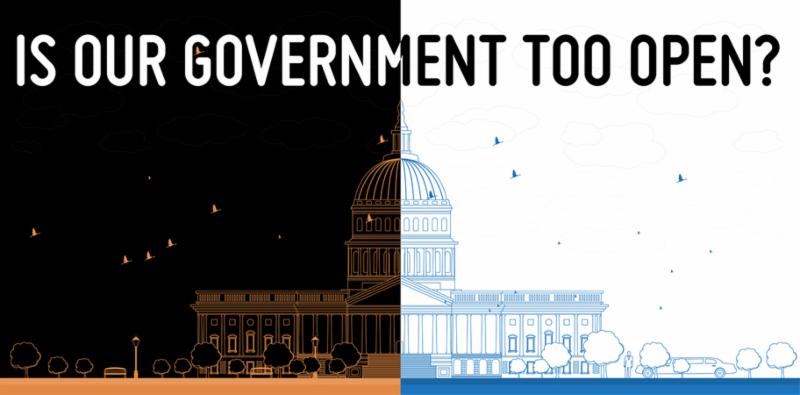
Debate: Is American government too open?
It’s been 50 years since the U.S. Congress adopted the Freedom of Information Act, which provides access to documents held by federal agencies. Since 1966, Congress has adopted many other laws designed to promote openness. But has the United States gone too far, undermining the capacity of public officials to solve our major problems?
In a commentary for Governance,Bruce Cain of Stanford University says yes, American government is now too open. And Charles Lewis of American University responds in a second commentary: No, it isn’t.
 Cain and Lewis engaged in an in-person debate about their commentaries at the University of Missouri on March 15. Watch the debate here.


Why voters sometimes prefer criminals as candidates
Written by Governance
October 24, 2016 at 2:50 pm
Posted in commentary