Studying accountability in moments of transformation
 In the current issue of Governance, Johan Olsen makes the case for a more sophisticated approach to the study of accountability in government. “A huge literature,” says Olsen, examines accountability in “normal times,” when “it is taken for granted who can call whom to account for what.” Less examined are those moments when fundamental premises about accountability relationships are in flux. We are passing through one of those transformational periods now, Olsen argues, and simple principal-agent models do not help us understand what is happening. His “institution-centered approach” to studying accountability “assumes that the degree of institutionalization of accountability practices is variable and changing.” The restructuring of such practices is shaped by “uncertainty about facts and causality, ambiguous and competing normative standards,” and indeterminate power relationships. Read the article. Olsen is a recipient of the APSA John Gaus Award and the Aaron Wildavsky Award for his contributions to public administration and political science.
Call for short papers: Is public management research neglecting the state?
 Professors Brint Milward and Alasdair Roberts invite expressions of interest from academics interested in participating in a panel to be held at the Public Management Research Conference at Aarhus University on June 22-24, 2016. The short papers produced for the panel will be published as a collection in Governance 30.3 (July 2016).
Individuals who participate in the panel will be asked to write a short paper, not exceeding 1500 words, for submission by January 30, 2016. The short paper should address the theme: “Is public management research neglecting the state?” By this, we mean to ask whether public management research gives adequate attention to topics such as (1) recent changes in the architecture of the state; (2) longer-term processes by which state capabilities evolve; (3) the ability of existing state structures to address emerging challenges such as terrorism, climate change, economic transformation, or mass migration; and (4) the adequacy of mechanisms for maintaining control and accountability over state structures.
This project continues a discussion begun during the plenary session on “the state and public management” that was held at the 2015 Public Management Research Conference at the Humphrey School of Public Affairs, University of Minnesota.
Expressions of interest, or requests for further information, should be sent to Brint Milward and Alasdair Roberts. Decisions about the composition of the panel will be made by November 30, 2015.
The Canadian federal election: What it means for policy and politics
 By Sandford Borins. The results of the Oct. 19 Canadian election were both definitive and surprising: a majority government for the Liberal Party of Canada, which in the previous election had run third and was in danger of disappearing, and the defeat of a decade-old Conservative regime that had won the three previous elections by increasing margins and governed with ruthless political efficiency. Though public sentiment that it was time for a change had grown, the two major left-of-centre parties, the Liberals and the New Democrats, were competing with one another to capitalize on that sentiment. The Liberal Party won the election with a platform that moved noticeably to the left, a leader who conveyed optimism and passion, and an advertising campaign that overcame the Conservatives’ expertise in negativism.
Book reviews: How states develop, the welfare of children, what the US expects from development
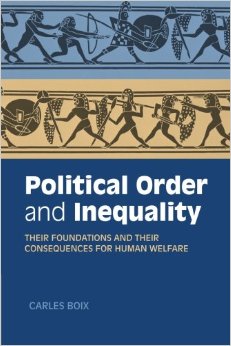 Steve Webb reviews Political Order and Inequality by Carles Boix. The book is a “valuable complement” to other recent attempts to explain why states exist and how they emerge. Read the review.
Olsen on democratic accountability: An appreciation
 Per Laegreid offers an appreciation of a new article in Governance by Johan Olsen: I find this article very interesting because it has an original and innovative flavor. It makes a significant contribution and new insights to the discipline, especially regarding how to understand democratic accountability relations in unsettled and transformative periods. Accountability is often studied in stable situations where relationships between actors and forums are rather clearly defined and when it is quite clear who is accountable to whom, for what and why. But there has been less attention to how accountability unfolds in disorganized situations where accountability processes are restructured.
Organizations are central to global governance
 By Angel Saz Carranza. As a complement to David Coen and Tom Pegram’s recent call for a renewed global governance research effort, I underscore the usefulness to include in such an effort the organization perspective. Global governance needs administrative and organization research.
Coen and Pegram correctly highlight the dire need to advance research on global governance by advancing inter-disciplinary and combining multiple methods. They call for the integration of International Relations (IR)—for long the sole disciplinary approach used to study of global governance-, European Public Policy Studies (EPP), and International Law approaches. Their call for a new generation of global governance research is very timely.


Reply to Coen and Pegram: The global liberal system is more fragile than you think
Read the rest of this entry »
Written by Governance
November 1, 2015 at 9:46 am
Posted in Blog comments, Coen Pegram commentary