Archive for the ‘Current issue’ Category
Canada dares to change, but cautiously
 In the current issue of Governance, Evert Lindquist and Chris Eichbaum argue that studies of Westminster systems need to expand their view beyond the relationship between politicians and public servants. The Westminster model also includes “tacit bargains” between ministers and caucuses, and between governments and the general public. Canada did not undertake reforms as radical as other Westminster systems. But the Harper government did upset the status quo, often provoking strong resistance. Lindquist and Eichbaum contrast Canadiandevelopments with other systems, and consider how the new Trudeau government may change course. Read the article. The article is part of a special issue on the future of the Westminster model.
10 reasons policymakers don’t use data effectively
 We are in the midst of a data revolution, Donald Kettl says in a research note in the current issue of Governance. But “we are generating data faster than we are devising strategies for hearing what it tells us and helping policymakers act on it.” Kettl outlines ten reasons why decision makers don’t make best use of the new bounty of data. By grappling with these ten problems, academics can “improve the odds that careful analysis, rather than the noisy background of ordinary knowledge, shapes policy.” Read the research note.
How the GFC changed ideas about ministerial control
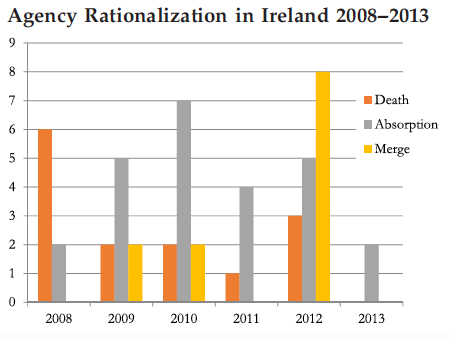 Before Brexit there was the global financial crisis. In the current issue of Governance, Katherine Dommett, Muiris MacCarthaigh, and Niamh Hardiman examine how the GFC changed ideas about the organization of bureaucracy in the United Kingdom and Ireland. The conventional Westminster model stressed centralization and ministerial control. The conventional model was weakened because of NPM-style reforms. But the authors find that the GFC caused another swing of the pendulum. Austerity drives resulted in “efforts to reassert central government oversight.” But the authors find that the end result was not simply a restoration of pre-NPM practices. Rather, it was a more nuanced process of “negotiated governance.” Read the article. The article is part of a special issue on the future of the Westminster model.
In Westminster systems, public servants hold the line
 In Westminster systems, senior public servants have traditionally avoided overtly political roles. Some critics have alleged that recent public sector reforms have undermined that tradition of impartiality. In the current issue of Governance,Dennis Grube and Cosmo Howard conclude that fears about the collapse of traditional norms are overstated. Drawing on cases from Canada and Australia, Grube and Howard conclude that “There remains a strong ethical awareness among senior public servants about how far they can legitimately allow themselves to be pushed under a Westminster system.” Read the article. The article is part of a special issue on the future of the Westminster model.
The Westminster ideal: A useful myth
How NPM made Westminster blunder-prone
 The Westminster model of governance created a “symbiotic partnership” between the ministers responsible for government departments and the career civil servants who ran them, David Richards and Martin J. Smith argue in the current issue ofGovernance. But the advent of New Public Management changed that, introducing new pathologies into British government. “The most crucial pathology,” they say, “is that the deliberative space afforded for critical engagement over public policy has been diminished.” The result? A government that is more vulnerable to serious blunders. Read the article. The article is part of a special issue on the future of the Westminster model.
Is the Westminster model dead?
 For more than a century, the Westminster system was one of the most influential models of public administration in the world. Countries in the “Westminster world” claimed the benefits of a strong executive and an impartial, professional bureaucracy. The October issue of Governance examines the health of the Westminster model today. In their introduction to the special issue, Dennis Grube and Cosmo Howard pose the big question: Is the model “under threat, dying, or already dead?” Read the introduction to the special issue.